> For the complete documentation index, see [llms.txt](https://docs.parcellab.com/docs/llms.txt). Markdown versions of documentation pages are available by appending `.md` to page URLs; this page is available as [Markdown](https://docs.parcellab.com/docs/platform/security-compliance/single-sign-on.md).
# Single Sign-On (SSO)
Using SSO authentication to access the parcelLab App provides a secure and quick method for your users to sign in with their corporate login credentials.
## Overview
SSO is an authentication method that enables users to securely access multiple applications and websites by using one set of login credentials.
parcelLab offers SSO implementation for industry-standard protocols for identification, such as Azure Active Directory (AD) SAML 2.0 and OpenID Connect (for example: Google OAuth). This feature also includes the flexibility to implement custom identity providers.
## Configuring SSO for space.vars.Product\_pLApp Access
parcelLab supports SSO using SAML 2.0 and OAuth as authorization methods.
Information about the implementation process is described in the following sections.
{% hint style="info" %}
For further queries on the scope and requirements of implementing SSO, please contact your parcelLab representative.
{% endhint %}
### Customer Requirements
To set up SSO with established identity providers, the information you need to provide is based on the identity provider. Details about the most common providers are listed below.
By default, all newly logged-in users will get "Guest" access rights and will only be able to view their user profile in the parcelLab App. Client administrator users will need to adjust the access rights for each user in the User Management module.
#### SAML
This section describes the requirements for implementing SSO with SAML 2.0.
For the implementation to work, you need to provide the following information:
* Discovery Endpoint URL (that is: the URL for your SAML identity provider's metadata)
* The URL has the following pattern: [https://login.microsoftonline.com/{uuid}/federationmetadata/2007-06/federationmetadata.xml?appid={uuid}](https://login.microsoftonline.com/%7Buuid%7D/federationmetadata/2007-06/federationmetadata.xml?appid={uuid})
* Your service provider's ID for the application\ 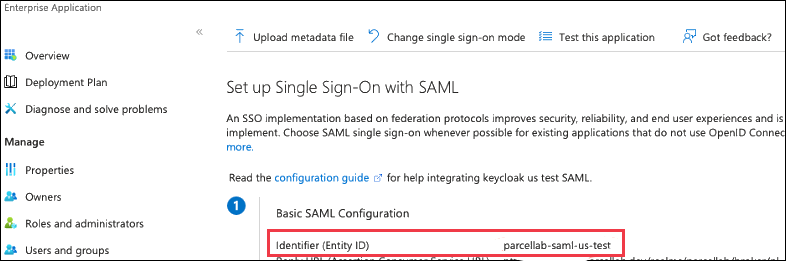 * A screenshot or table of the configured claims for the SAML token
#### OpenID Connect
This section describes the requirements for implementing SSO with OpenID Connect.
For the implementation to work, you need to provide the following information:
* Discovery Endpoint URL (that is: the URL for the Open ID configuration)
* The URL has the following pattern: [https://{domain}/{optionalPath}/.well-known/openid-configuration](https://{domain}/%7BoptionalPath%7D/.well-known/openid-configuration) (for example: )
* Client ID (that is: the unique identifier for your registered application)
* Client Secret (that is: the password (string) of your application)
### Implementation Process
In this section, the implementation process for SSO integration is described.
When parcelLab has the required information, the integration process can begin.
#### Adding Redirect URLs to Your Configuration
After implementing the SSO connection, parcelLab will provide redirect URLs that you need to add to your SAML or OIDC connection.
After you have added the redirect URLs to your configuration, your users can use their corporate login credentials to sign in to parcelLab.
---
# Agent Instructions
This documentation is published with GitBook. GitBook is the documentation platform designed so that both humans and AI agents can read, navigate, and reason over technical content effectively. Learn more at gitbook.com.
## Querying This Documentation
If you need additional information that is not directly available in this page, you can query the documentation by asking a question.
Perform an HTTP GET request on the following URL with the `ask` and `goal` query parameters:
```
GET https://docs.parcellab.com/docs/platform/security-compliance/single-sign-on.md?ask=&goal=
```
`ask` is the immediate question: it should be specific, self-contained, and written in natural language.
`goal` is what the user is ultimately trying to achieve, the reason they need the answer. Sharing it helps GitBook give you a better, more relevant answer. A goal is most helpful when it describes the outcome the user wants rather than restating the question. For example, with `ask=how do I create an API token`, a goal like `automate deployments from our CI pipeline` lets GitBook tailor the answer to that use case.
The response will contain a direct answer to the question and relevant excerpts and sources from the documentation.
Use this mechanism when the answer is not explicitly present in the current page, you need clarification or additional context, or you want to retrieve related documentation sections.